Eric Boehlert is at it again.
The dressed-as-a-pimp storyline was one Breitbart, O’Keefe, and others eagerly pushed last fall. And it was one the press quickly embraced. (In truth, O’Keefe was often dressed rather conservatively — slacks and dress shirt — when he talked to ACORN staffers, and he often presented himself as a law school student and an aspiring politician trying to rescue his prostitute girlfriend from her abusive pimp.)
The italicized “from” is Boehlert’s way of implying that O’Keefe never pretended to be a pimp at ACORN. In fact, he knows full well that O’Keefe pretended to be a pimp at ACORN. The fact that he portrayed himself as the good pimp doesn’t mean he wasn’t playing a pimp.
As I document in this thorough post below, O’Keefe repeatedly told ACORN employees that he was setting up a house where Giles and underage girls would turn tricks, and give the proceeds to O’Keefe, who planned to use them for a future Congressional campaign. The tapes have numerous exchanges like this:
O’Keefe: But, one of the things I was one of the things we also wanna do um one of my goals you asked you asked do you know how you wanna do this, I think one of the goals is not only can Eden protect some of these 13, 14, 15 year-old girls
Theresa (ACORN) Yeah.
O’Keefe: coming over from El Salvador. In addition to protecting them and getting their feet on the ground so that they can you know perform the tricks and you know learn the how LA prostitution scene is I was also wanting to um use some of the this is very lucrative and potentially we can use a lot of the money we’re getting from the underaged girls from El Salvador and use some of the money for campaign one day
. . . .
O’Keefe: We’re bringing these girls from overseas.
Hannah (Eden) Well, they’re here.
O’Keefe: But, we are gonna take a part of the profit and I intend to use the profit
Theresa (ACORN): Right.
O’Keefe: From the tricks the girls perform
Theresa (ACORN): Right.
O’Keefe: To fund my political campaign.
Theresa (ACORN): Right.
Boehlert knows O’Keefe posed as a pimp. But he won’t say so. I have offered to give Boehlert $100 (commenters have bumped the offer to $200) simply to state clearly whether O’Keefe pretended to be a pimp at ACORN. He knows that O’Keefe did, but if he says so, he can’t insinuate that he didn’t, by harping on the clothing non-issue.
Boehlert won’t tell you that O’Keefe pretended to be a pimp, but he is willing to further claims by others who deceptively claim O’Keefe did not. Today Boehlert posts a misleading, deceptive, and highly doctored video by Mike Stark which makes that claim:
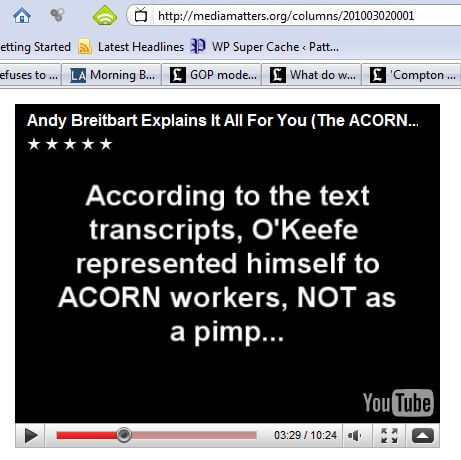
As I showed in this post, Boehlert labeled Giles and O’Keefe hoaxsters because they did not correct statements or implications by others that O’Keefe wore the pimp getup in ACORN offices. Yet he is content to post a video on his site that makes a false claim that O’Keefe never played a pimp. By Boehlert’s own standards, that makes him a hoaxster himself.
P.S. ACORN supporters are also claiming vindication because the Brooklyn D.A. yesterday issued a statement refusing to prosecute ACORN. They are especially excited because an anonymous source claimed that the videotapes were edited deceptively. Well, if we can’t trust an anonymous source nowadays, who can we trust?
The fact is that the full audio and transcript of the Brooklyn ACORN video is available and shows that the tape was not deceptively edited. If someone has a case to make otherwise, let them come forward and make it. My guess: the anonymous source (whoever it was) was a Democrat hack who didn’t release their name because they knew their partisanship would be discovered.